Most padel court projects in the UK will likely need planning permission. They usually involve outdoor construction with permanent glass and steel structures, floodlights and earthwork.
Many padel projects are commercial facilities that bring more activity to the site, higher noise levels or a change in how the land is used. Any of those can trigger a planning review.
Approval for a padel court is usually assessed case by case, because planning requirements in the UK vary a lot depending on the location and the local rules that apply.
If you own the site, it pays to know those rules and planning considerations before your UK padel court project gets underway.
Thinking about a padel project in the UK? Talk to the experts at MejorSet for specialist guidance and advice tailored to your site.
Yes. In most cases, a padel court project in the UK will need planning permission. That is the approval a local council grants for most new construction or a change of land use, roughly what a US owner would go through with zoning and site plan review. Courts usually involve permanent structures and wider impacts such as:
Commercial use can bring more visitors, longer operating hours and even a change of use for the land. The final requirements depend on the local planning authority, the council department that decides planning applications in each area.
Planning permission is usually decided case by case, and different types of projects face different planning considerations.
Outdoor padel courts account for the largest share of planning applications because they have the biggest impact on their surroundings.
These projects usually involve permanent enclosures, significant earthwork, drainage systems and lighting for evening play.
The main planning considerations are hours of operation, how close the court sits to neighboring properties, and its noise and visual impact.
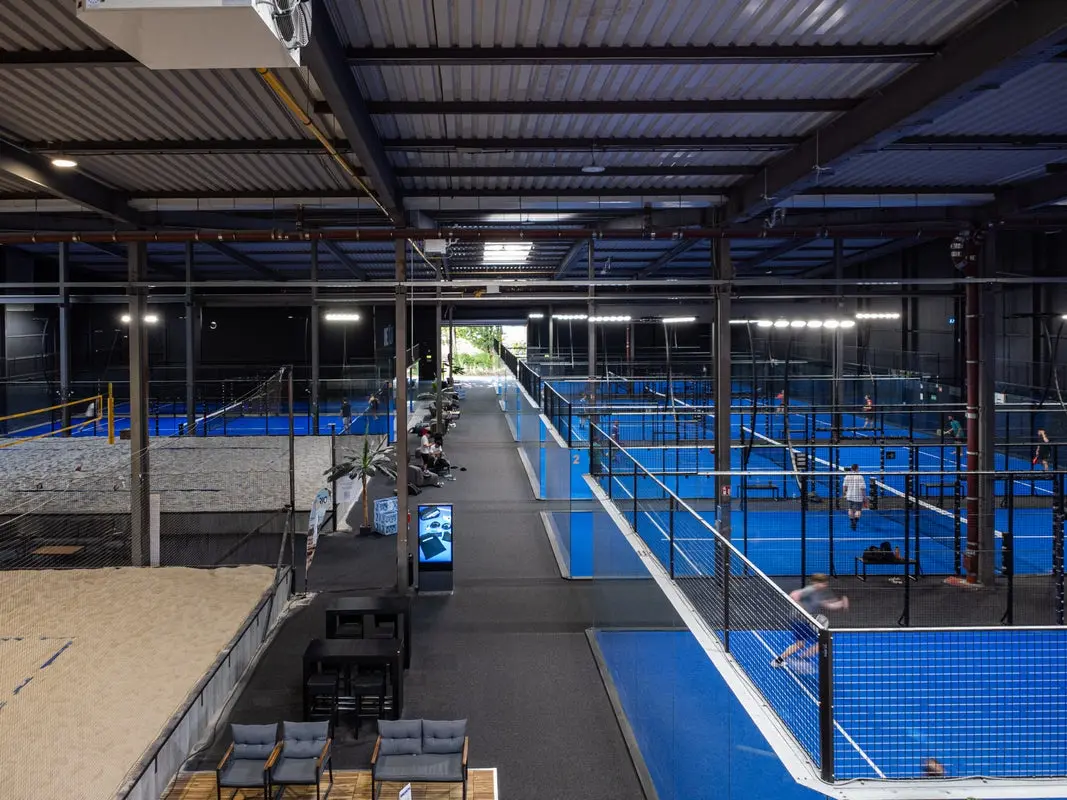
Indoor padel courts in buildings such as warehouses, recreation centers, gyms or indoor sports facilities can still be subject to planning requirements. Check with the local authority before you install a new court.
Permission may also be needed when the land use changes, for example when a warehouse or industrial building becomes a recreation facility. The authority may look at whether traffic or parking demand will go up.
You may also need permission for major construction work, such as extensions or structural alterations. In some cases, a change in operating hours can trigger planning requirements too.
Indoor facilities tend to get approved more easily, since they usually have less visual impact on the area than outdoor courts.
Private residential padel courts often need planning permission and can be hard to get approved because of their size and their impact on neighboring homes.
A standard padel court measures about 66 × 33 ft (20 × 10 m). Depending on the size of the backyard (a garden, in British terms), it can dominate the lot, which makes approval harder.
Neighbors often object to the height of the enclosure, the noise from play and the light pollution, especially when homes are close by.
Approval is more likely on properties with large backyards that sit farther away from other homes.
Getting planning permission on Green Belt land, the protected open countryside that rings many UK towns and cities, or on other sensitive sites such as conservation areas (districts protected for their historic or architectural character, much like US historic districts), protected landscapes or flood zones can be considerably harder, though not impossible.
These places are usually protected for their historic, environmental or ecological value.
That is why these projects usually need a stronger case and the support of planning specialists who can show the project's exceptional circumstances and the steps planned to keep its impact on the site to a minimum.
| Project type | Planning risk | Key documents | Common mitigation |
|---|---|---|---|
| Outdoor padel courts | Medium | Site plan, noise assessment | Acoustic barriers, directional lighting |
| Indoor padel courts | Low | Change of use statement, parking plan | Use of existing buildings, interior soundproofing |
| Backyard padel courts | High | Site plan, lighting and noise assessment | Choosing larger lots, limited lighting |
| Green Belt land or sensitive sites | Very high | Site plan, ecology or heritage report | Strong design justification, minimal environmental footprint |
The cost of installing a padel court in the UK depends on several factors, including:
When you choose a padel court supplier, look at the value over the long run. SG Padel supplies MejorSet's durable, high-quality FIP-certified courts in the UK, built to give clubs, sports facilities and other operators infrastructure that holds up for years.
Contact MejorSet for a custom quote and advice on court supply in the UK.
Before you apply, it helps to know which specifications can affect approval.
The most common ones are:
Bringing in an experienced padel court supplier from day one helps make sure the specifications work both for planning approval and for running the facility over the long term.
When you apply for a padel court in the UK, you may need to submit documents such as:
The exact paperwork varies by local authority and by site.
Noise is one of the biggest considerations for padel courts. The sound of play and long operating hours can affect people living nearby.
Good acoustic design can reduce the noise impact, and in many cases a formal noise assessment is required to show the expected effect on neighbors.
Artificial lighting can cause light pollution and affect neighboring properties, especially at night and in winter.
Planning authorities will review the design and direction of the lighting to judge its impact on the surroundings.
Padel facilities can increase traffic and parking demand, especially at peak times.
Authorities will check that the site has safe, suitable access for both players and staff.
Padel courts are large structures that can change the views around them.
The height of the enclosure and fencing can affect natural light and how open the area feels.
Padel courts need effective drainage systems to handle surface water and maintain good playing conditions.
Planning authorities may also need to assess the ecological impact and any effects on the natural surroundings during construction.
The process can look complicated, but taking it step by step makes it simpler:
There are several ways to give a padel project a better chance of success.
Before you apply:
MejorSet has more than 20 years of experience installing padel courts in more than 75 countries. As a padel court manufacturer, it builds courts for clubs, sports facilities, hotels and resorts, residential projects and professional venues around the world.
SG Padel is our recommended official distributor in the UK and installs MejorSet courts there. At MejorSet, we support the planning process with information on court models, technical specifications and design considerations, along with product advice and coordination with suppliers.
Planning a padel court in the UK? Contact us and we will put you in touch with SG Padel, our local distributor.